

How Much Does a House Extension Cost in the UK in 2026?
A Simple Question With a Complex Answer
“How much will my house extension cost?”
It’s one of the first questions Edinburgh homeowners ask — and understandably so. But it’s also a question that rarely has a simple or immediate answer.
House extensions are not commodity purchases. They are bespoke architectural projects shaped by the existing building, planning context, construction complexity and the level of quality you expect. In a city like Edinburgh — defined by historic buildings, conservation areas and established neighbourhoods — those factors matter more than headline figures.
This guide explains house extension costs in the UK in 2026, with a specific focus on Edinburgh. It is written for homeowners planning thoughtful, design-led projects who want clarity rather than false certainty — and who understand that quality, longevity and good design require appropriate investment.
1. The Cost Per Square Metre Is Only the Starting Point
Many online guides quote a cost per square metre as a quick way to estimate a house extension cost in the UK. While this can be a useful starting reference, it is not a complete picture.
In 2026, build costs for extensions in Edinburgh typically sit above UK-wide averages, reflecting labour availability, specialist construction methods and the city’s architectural context. Square-metre rates generally refer to the core build only — the structural shell of the extension.
Extension Type
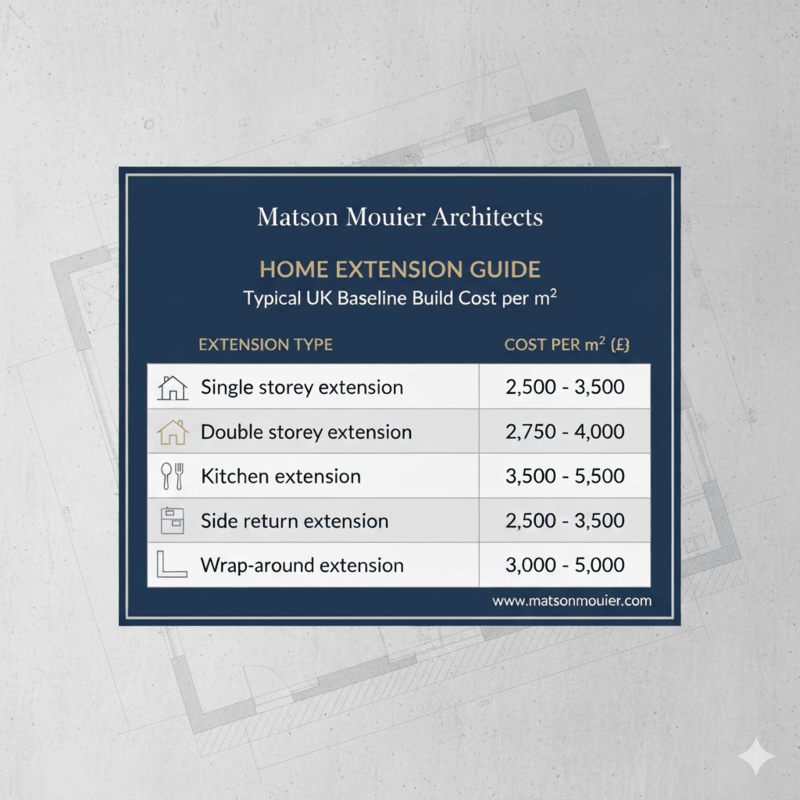
These figures generally represent the core construction shell only — foundations, structure, walls, roof, insulation, standard windows and doors, plastering and basic services.
What they do not include is where many homeowners are caught out:
kitchens, bathrooms, bespoke glazing, joinery, professional fees, statutory approvals, landscaping or external works.
The gap between a watertight shell and a finished home is often the single biggest source of budget shock.
2. Finishes, Fees and Compliance Shape the Real Budget
For high-quality, design-led projects, the difference between baseline build cost and total project investment can be significant.
Finishes such as kitchens, bathrooms and fitted joinery are not optional extras — they define how the space works and how it feels to live in. At the same time, professional input is essential to ensure the project is properly designed, compliant and buildable.
Costs that are frequently underestimated include:
Architectural design and technical coordination
Structural engineering and specialist consultants
Measured surveys and site investigations
Planning permission and Building Warrant fees (Scotland)
Conservation or listed-building detailing where applicable - A sensible contingency for unforeseen site conditions
In Edinburgh’s older housing stock, additional structural intervention is common once buildings are opened up. Allowing properly for this from the outset is part of responsible budgeting — and a clear indicator of a well-considered project.
3. Edinburgh’s Architecture Adds Value — and Complexity
A house extension in Edinburgh is rarely straightforward. Many homes are traditional stone buildings, located within conservation areas and subject to tighter planning controls than elsewhere in the UK.
Common factors influencing cost include: - Older construction types requiring specialist structural solutions - Higher expectations around materials, proportions and detailing - Restricted site access to rear gardens in terraces and tenements - Increased scrutiny from planning authorities in sensitive locations
These conditions place greater emphasis on careful design and technical resolution. Working with an experienced house extension architect in Edinburgh helps navigate these constraints efficiently, reducing risk and avoiding costly redesigns later.
Extending a period property is, in many ways, a dialogue with history. Done well, it enhances both the building’s character and its long-term value — but it requires time, skill and appropriate investment.
4. Quality Projects Take Time: Expect 12–18 Months
One of the biggest surprises for homeowners is not cost, but programme length.
In practice, a well-considered house extension in Edinburgh often takes 12 to 18 months from initial consultation to completion. This is not inefficiency — it is the result of a diligent, sequential process shaped by statutory approvals and contractor availability.
A typical programme includes:
Initial consultation, surveys and concept design
Planning permission (often 8–16 weeks, longer in sensitive areas)
Building Warrant approval in Scotland (typically 8–12 weeks)
Detailed technical design and coordination
Contractor tendering and scheduling
Construction on site (commonly 6–8 months for substantial extensions)
Reputable contractors are in high demand and often have waiting lists, which can influence start dates. Rather than viewing this as delay, it should be seen as a sign of quality: good projects take time because they are properly designed, properly approved and properly built.
5. Intelligent Design Is the Most Effective Cost Control
The most effective way to manage house extension costs is not through cutting corners on site, but through intelligent design decisions made early.
Strategic choices that can significantly influence cost include: - Carefully controlling the extension footprint to maximise impact - Minimising unnecessary structural alteration to the existing house - Selecting roof forms that balance cost, performance and aesthetics - Choosing glazing strategies that deliver light without over-complication
This is where working with a design-led architect Edinburgh homeowners trust adds real value. Good design focuses investment where it improves daily life, long-term performance and architectural quality — rather than spreading budget thinly across unnecessary complexity.
Investment Scenarios: Realistic Project Scales
Rather than thinking in fixed budgets, it is often more helpful to consider extension projects in terms of scope and ambition.
Design-Led Kitchen and Living Extension
A substantial ground-floor extension focused on improving light, layout and connection to the garden. These projects typically involve structural alterations to the existing house, high-quality glazing and carefully coordinated interior detailing to create a cohesive, long-term improvement to how the home functions.
Whole-Home Architectural Transformation
A larger-scale project combining a wrap-around or multi-storey extension with significant internal reconfiguration and potentially a loft conversion. These schemes often include bespoke joinery, premium materials and fully integrated building services, resulting in a comprehensive transformation rather than a single addition.
How to Start Your House Extension Project in Edinburgh
Initial consultation to discuss aspirations and feasibility
Measured survey of the existing property
Concept design and spatial testing
Planning permission or permitted development assessment
Building Warrant Application
Detailed technical design
Contractor tendering and appointment
Construction and site support
Clear structure and professional guidance at each stage are essential to achieving a predictable, well-executed outcome.
Planning With Clarity, Not Guesswork
House extension costs in Edinburgh vary widely, but informed planning prevents expensive surprises. The city’s architectural heritage, planning context and regulatory environment mean that specialist knowledge is essential.
Matson Mourier works with homeowners across Edinburgh, Midlothian and East Lothian who value thoughtful, design-led residential architecture. If you are considering a house extension and want clear advice on cost, feasibility and design potential — tailored to your property — our team would be pleased to guide you from early feasibility through to completion.
Frequently Asked Questions
How do I estimate the budget for my extension?
Start with UK baseline m² costs, then factor in site complexity, specification choices, professional fees and a sensible contingency.
Is planning permission needed for an extension in Edinburgh?
It depends on size, location and conservation status. Many properties require planning consent.
How long does a house extension take?
From initial consultation to completion, a well-considered project commonly takes 12–18 months.
Do I need an architect for a house extension?
An architect is not legally required, but their involvement significantly improves design quality, cost control and regulatory compliance.

